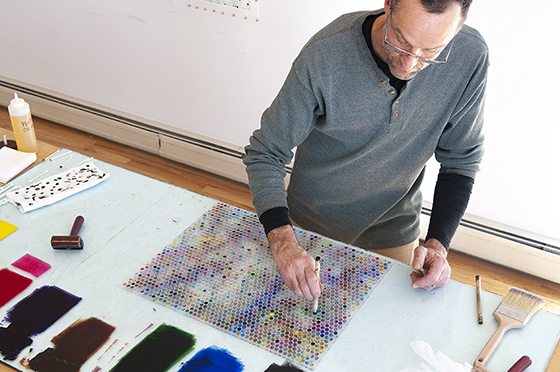
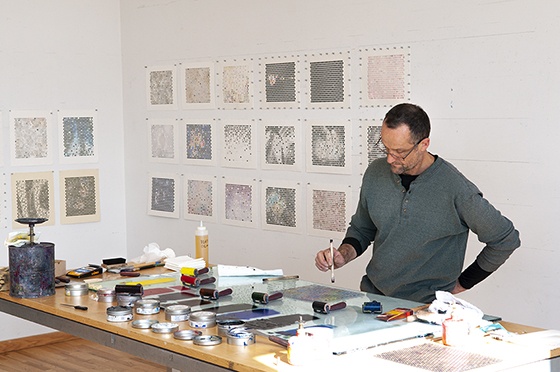
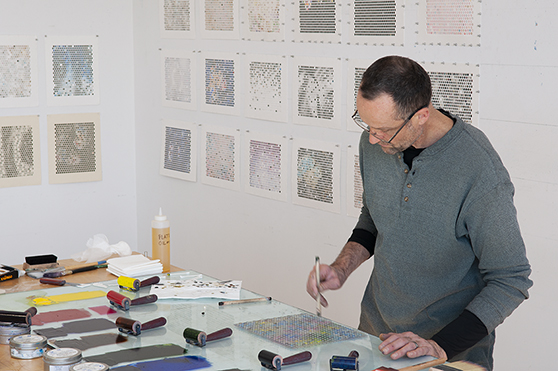
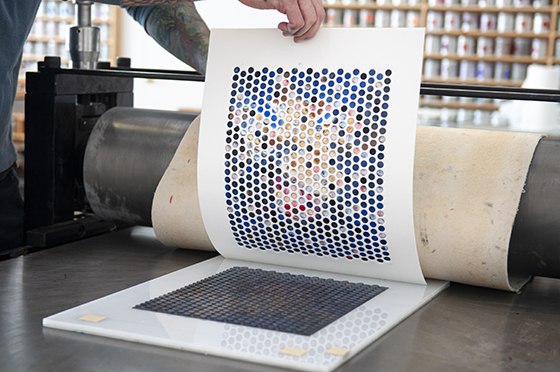
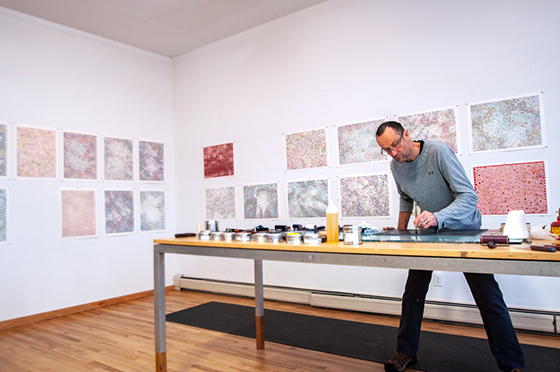
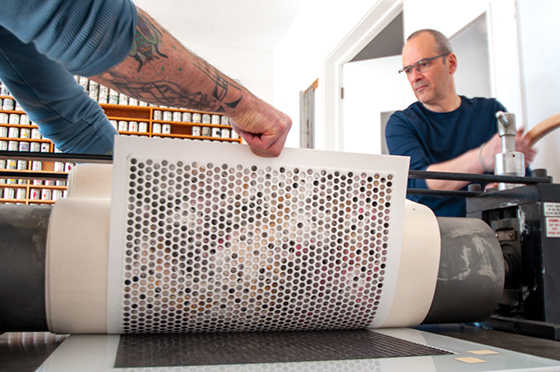
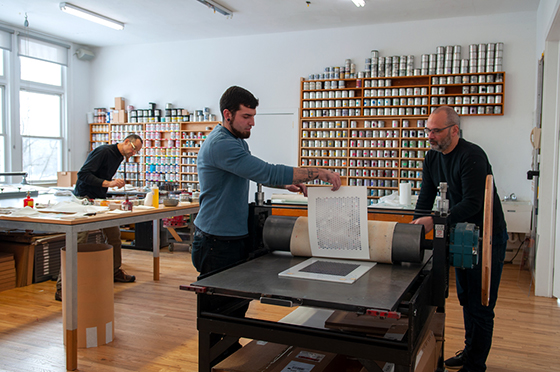
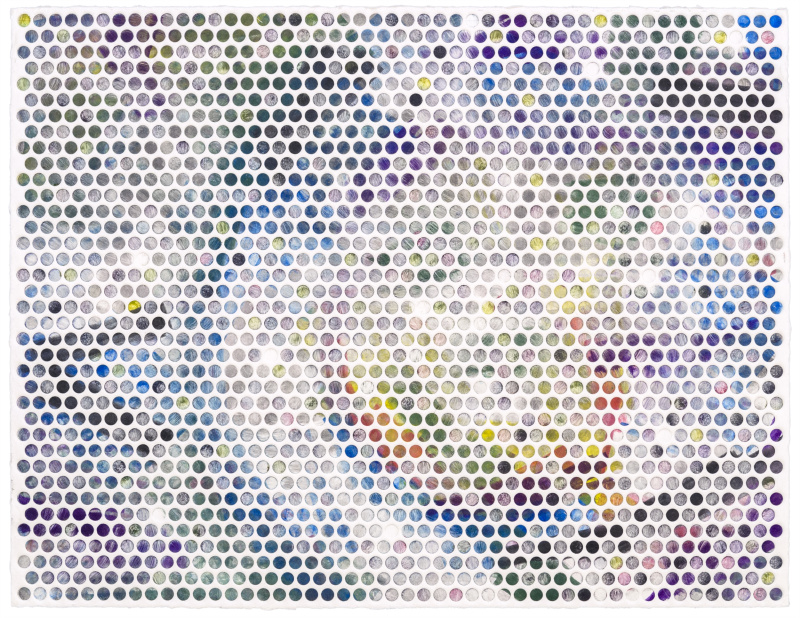
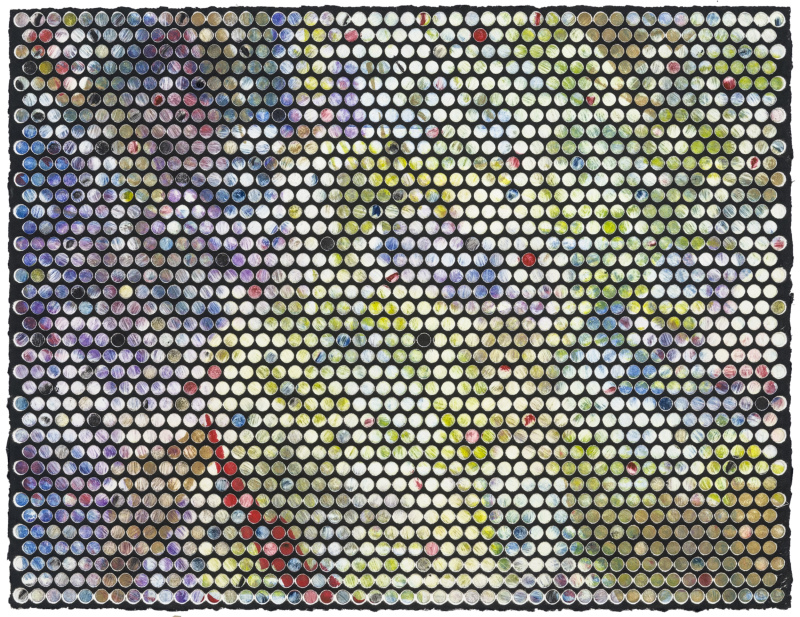
Emil Lukas and Durham Press have completed their most recent collaboration: Double Event, a series of relief monotypes inspired by the artist’s abstract dot-structure paintings. The prints were produced in a range of colorways and sizes, from 10 by 12 inches to 32 by 48 inches, and are available both as individuals and as sets of six grouped together by Lukas.
Known for his process-oriented works that investigate visual perception and reimagine everyday, industrial, or otherwise unconventional materials, Lukas has long been drawn to the image-making potential of the bubble-wrap pattern. In his painting practice, he utilizes this ubiquitous packing and shipping product by casting it in plaster and applying acrylic paint to the resulting concave impressions—each of which is slightly different than the one beside it, revealing individuating creases from the plastic as well as manufacturer’s imperfections. In 2013, with Durham Press, he began to create soft-ground etchings that continue to explore of the material’s grid-like pattern and varied textures.
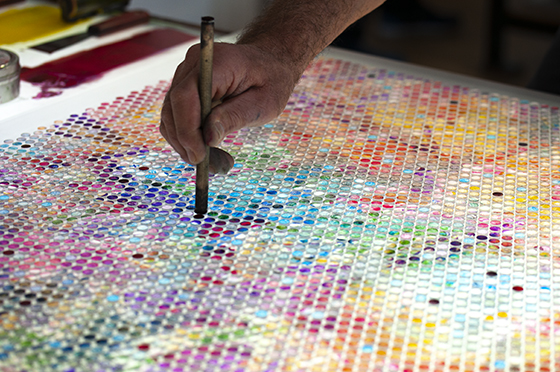
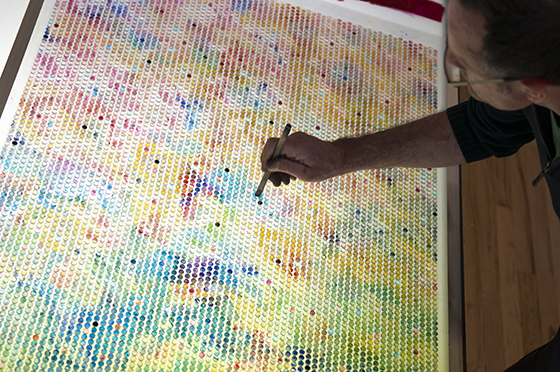
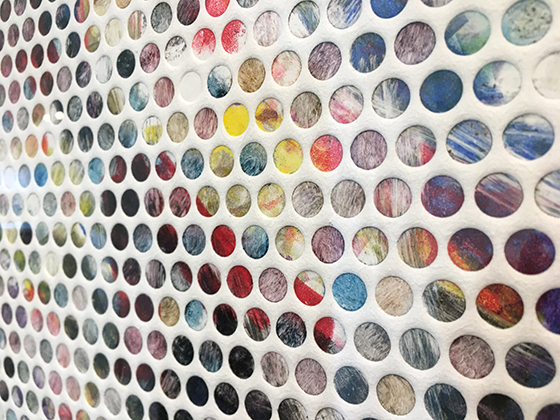
Lukas’s new monoprints, his most recent iteration on this theme, were produced in relief and bring new attention to the dimensionality of the circular marks. Presented on handmade, triple-thick paper, these shapes are significantly debossed, imbuing the prints with an almost sculptural quality akin to the plaster surfaces of his paintings. Their title, Double Event, refers to how such deep impressions in the paper generate two distinct viewing experiences. Rather than focusing on the total image at once, one’s eye tends to fix on either the protruding overall structure or the activity of color that occurs in the indentations.
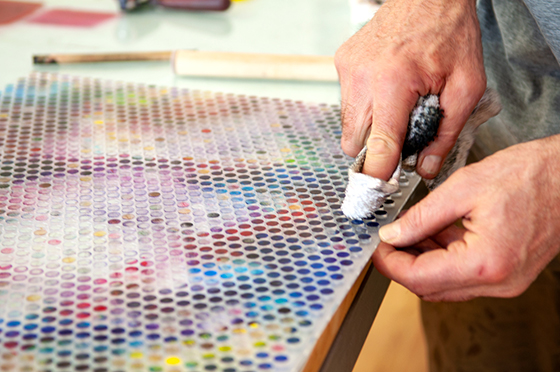
To apply color, Lukas not only used brayers, the traditional method for rolling ink onto blocks, but also engaged other techniques to achieve more painterly marks. This hands-on, fluid process allowed him to experiment chromatically on multiple scales: within the individual circle, across an entire composition, and between several prints in a set. In certain works, he also introduced red or black to the rounded frontal grid of the dot structure. Though seemingly simple, this change further plays with perspective; with the addition of color, this negative, “background” space becomes foregrounded, which, in turn, reemphasizes the debossment’s effect. Such transformations, carried out with everyday materials and simple means, demonstrate the myriad ways a single image can be perceived and suggest, in Lukas words, “the possibility that the infinity of color cannot be exhausted.”
Double Event is available directly from Durham Press. For more information about this series— or previous monoprints and editions by Emil Lukas please contact us.