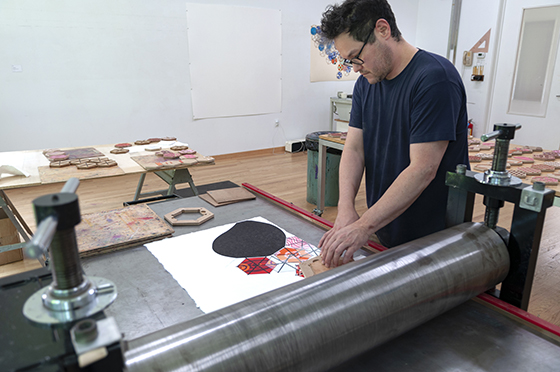
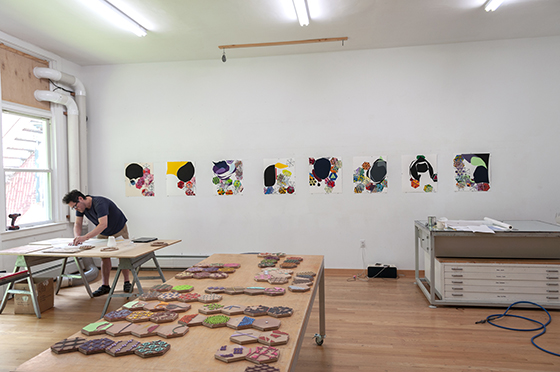
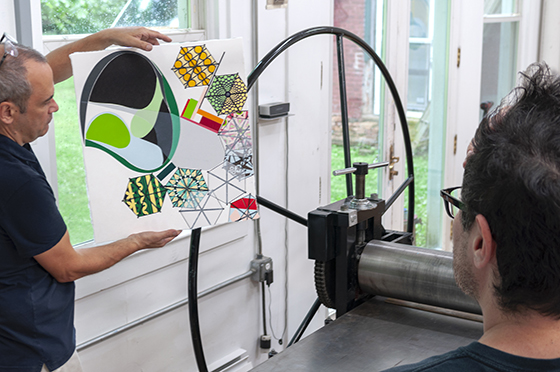
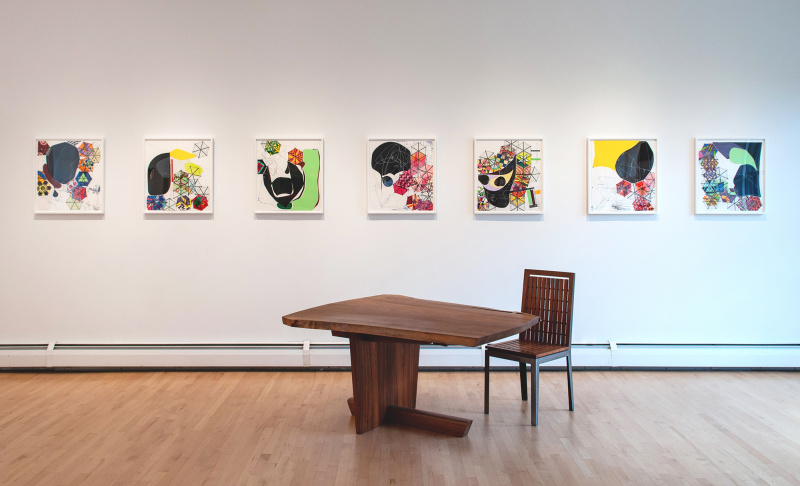
Jacob Hashimoto and Durham Press are pleased to announce the launch of a series of twelve new prints combining relief and silkscreen. Titled The Necessary Invention of the Mind, the new series continues to engage with the artist’s signature kite imagery, while at the same time using the specific possibilities of print to explore imaginative new compositions. The series is produced in editions of thirty-seven and measure 22 7/8 x 20 5/8 inches each.
Hashimoto has become known for his complex constructions featuring hundreds, often thousands, of paper and bamboo kites. Evoking twentieth-century traditions of landscape-based abstraction and the pixelated makeup of more recent digital worlds, these works have an ethereal, floating presence. Whether presented on the wall as canvas-like arrangements or hung from ceiling in expansive, site-specific installations, they are nevertheless beholden to structural constraints, their string supports, and above all, gravity.
In the printmaking studio Hashimoto has begun to question and play with these limitations. For previous collaborations with Durham Press—most recently, Cloud Reservoirs in Finite Glitch Space, a series of large-scale monoprints from 2018—he used his kite forms to depict “magic space,” or to produce compositions that “couldn’t happen in real space.” The kites are untethered and appear to levitate, ascend, or tumble playfully across the white-paper background.
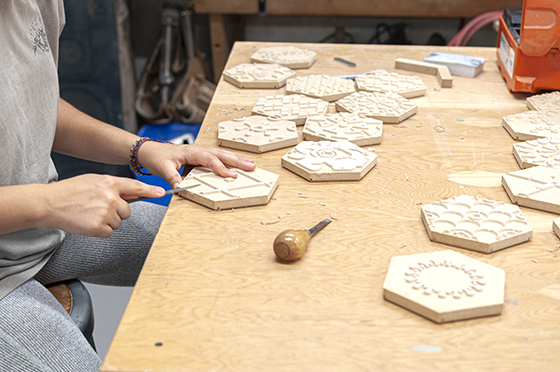
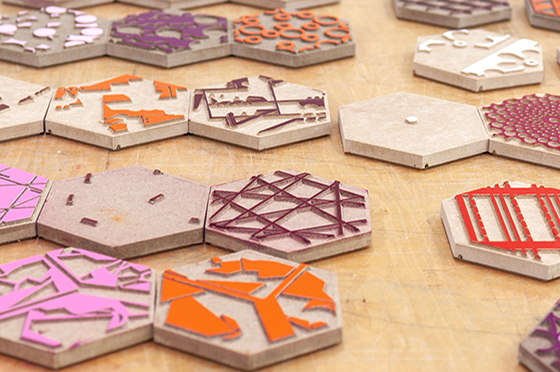
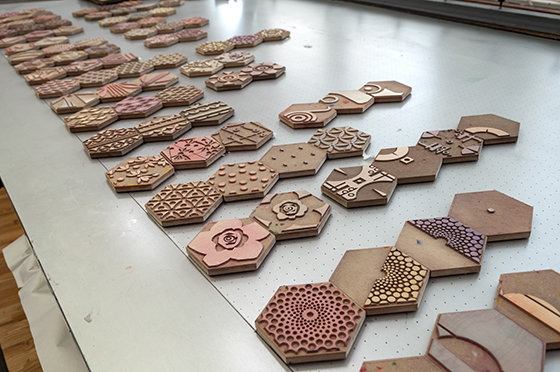
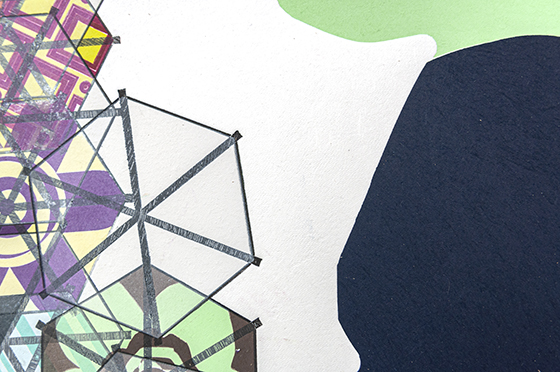
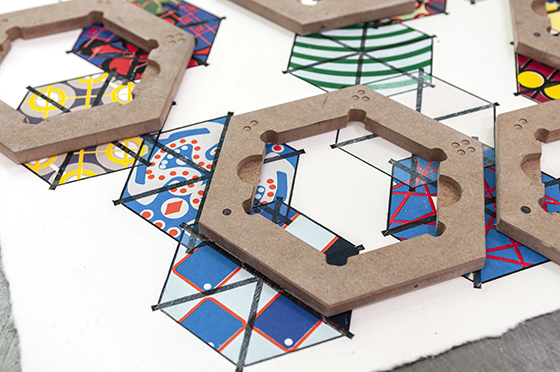
The prints in The Necessary Invention of the Mind take these experiments a step further, presenting twelve compositions with amorphous, abstract shapes that appear to give off their own gravitational fields. The hexagonal kites respond to the contours of these enigmatic masses of color, surrounding them in various formations—some of which are concentrated and dense; others, relatively scattered and sparse. Hashimoto created these blocks using woodworking tools at Durham Press. Cut intuitively on a band saw, they feature uneven edges that convey a sense of the artist’s hand and contrast with the precision of the kites, which were made with a computer numerical control (CNC) router.
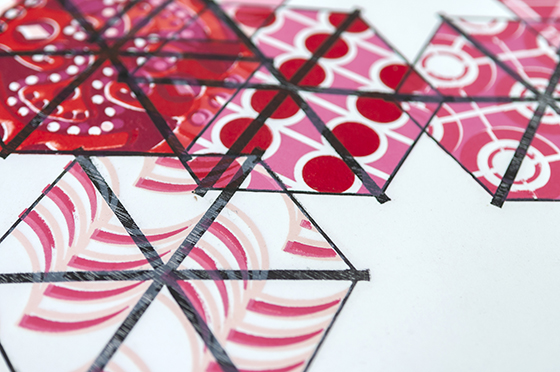
Hashimoto’s freehand approach continued throughout the production process. He chose the colors in a similarly instinctual manner and then scribbled marks across each work. These lines recall the strings that brace and support the artist’s kite installations, but instead of being taut and vertical, here they move playfully across the page, twisting around, over, and under the other shapes. Through these gestures, Hashimoto suggests that it is not the kites that are suspended, but rather the laws of physics themselves.
For more information about the series or previous collaborations between Hashimoto and Durham Press, please contact us at sales@durhampress.com